Glimpses of Modern Indian Philately

This blog is devoted to Modern Indian Postal History and Modern Philately of India providing less known information on various aspects of Indian Postal Services.

.

.


Registered mail posted in Dec. 1949 from Nepal to India.
Reg. slip No.R-167  shows the words "INDIAN EMBASSY
NEPAL" & " BRITISH LEGATION NEPAL"


The British Legation (Nepal) P.O. was transformed into Indian embassy (Nepal) PO after India's Independence on 15th August 1947, but no specific date is recorded yet. Mr. Wolfgang C. Hellrigl also in his book "Nepal Postal History" doesn't give any specific date when legation office was taken over by Indian Embassy. But in my opinion, the transformation date should be 1st April 1948 and reason for my belief, are as follows:

 
India was divided on 14th-15th August 1947 at night. But the postal treatment towards Pakistan was finalised on and from 1st April 1948 only.

The Postal administration of Persian Gulf countries i.e. Bahrain, Dubai, Kuwait and Muscat was handed over by India to British Post Office Agencies on and from 1st April 1948.

It is recorded in Nepal Postal History by Wolfgang that the Postal Markings were altered from British Legation (Nepal) to Indian Embassy (Nepal), in between 23rd April 1948 and 10th May 1948. It means that the change in Postal Cancellation took place after 1st April 1948 and it also means that if alteration would have taken place earlier, the cancellation would have appeared earlier.

The Indian Embassy (Nepal) PO or British Legation (Nepal) PO or Residency PO was the name of the Indian Post Office in Nepal. The Residency PO started functioning in Kathmandu, Nepal in the year 1816. It continued till 1920 when it became British Legation PO, but postal markings were changed in 1941. After India's Independence the charge of this Indian PO was handed over to Indian Embassy in Nepal on 1st April 1948, and the postal markings were changed in between 23rd April 1948 and 10th May 1948. It was closed on and from 12th April 1965. 


Privately printed FDC with the Cancellation inscribed words:
"INDIAN EMBASSY (NEPAL)".


The Indian Post Office, which worked for 149 years in Nepal, was actually worked as a Foreign Post Office of Nepal. All foreign letters (excluding India) had to be forwarded to its destination through this Post Office. Before 1950, Nepal had a rigid policy of isolation, which was relaxed during the early 1950's. Since then, Tourists Mail started flowing through Indian Embassy PO Mail arrangements between India and Nepal were as follows:

Fully Prepaid Unregistered correspondence namely, Letters, Single Post Cards, Printed papers, Business Papers, Samples and unregistered News Papers could be sent by the Post offices in India to Nepal through the offices of Exchange.

Reply Paid Post Cards, Money Order and V. P. Post Services were not available between two countries.

Registration, Insurance and Parcel Service were also not available throughout Nepal except kathmandu where Indian Post Office - Indian Embassy PO Nepal was working.

It means that Parcels within a limit of 400 tolas, Registered and Insured articles, addressed to and/ or care of this Indian Embassy PO, could be accepted. In case the addressee is not a member of the Indian Embassy, the Registered and Insured articles were handed over by the Indian Embassy (Nepal) PO to a representative of the Nepalese PO at Kathmandu, under acquittance and the later effects delivery. The above rules are recorded in Section XII of P & T Guide July 1948 and clarification there after are recorded in DGPO Circular No.49 dated 29th November 1949.

Source: Mr. Ashok Kumar Bayanwala, Ahmedabad.

The Persian Gulf is in between Iran and Saudi Arabia. It runs from the mouth of "Shatt el Arab" in north, to the "Strait of Oman" in the south. Its length is 600Kms and the breadth varies from 290 kms to 46kms.

The first Western Power in the Gulf was Portuguese, which came in between 1481 and 1487. They remained supreme in Gulf till 1621 and ceased to exist in between 1640 and 1650.

The British arrived in 1598, established first factory at Jask in 1619 and remained in low note. The Dutch visited Gulf in 1624 and soon became supreme in trade. They remained masters of the trade till 1708 but by 1760's lost all trade.
Thus British became paramount. "Treaty of Peace in Perpetuity" was signed in 1853. And its main function was the British Government should keep the peace in the Persian Gulf and all maritime disputes should be referred to them for arbitration.

Different treaties and agreements were signed, by which Great Britain alone was empowered to establish a Postal Administration. The Britishers opened Post Offices under Indian Postal Administration.

The first Postal Agency in the Gulf was opened at Muscat in 1856. Since then Bushire (1857), Ling (1867), Bandar Abbas (1867), Jask (1880), Bahrain (1884), Mahommera (1892), Kuwait (1904), Dubai (1909), Henjam (1913), Abadan (1914) and Ahwaj (1914) were opened. After the World War I, the conditions and values changed. The British influence was undermined. In 1923, all Indian Postal Agencies in Persia closed down. Only in areas on the western shore of the Gulf, the Postal Agencies continued in Bahrain, Dubai, Kuwait and Muscat.

These 4 Postal Agencies were first under Bombay Circle and afterwards under Sind Circle but managed all along from Karachi Foreign P.O. They were using Indian Stamps but from 1st April 1923. Kuwait started using Indian Stamps overprinted "Kuwait" and from 1933, Bahrain started using Indian Stamps overprinted "Bahrain" and Muscat & Dubai went on using Indian Stamps without any overprint. We still find Indian Stamps without overprint "Kuwait" being used from Kuwait. Therefore, after partition of India Dubai and Muscat used Pakistan Stamps from 1st October 1947 till 31st March 1948.

The Postal Administration of Bahrain, Dubai, Kuwait and Muscat in the Persian Gulf was taken over by His Majesty's Government and British Postal Office Agencies on and from 1st April 1948. Therefore, postal articles for and from the Postal Agencies were treated as foreign postal articles from 1st April 1948, vide Postal Notice No.67 dated 30th March 1948. 

Correspondence for and from the Postal Agencies were of the following categories:
Letters, Single and reply paid post cards, Printed papers, Business papers, Sample packets and Blind literature packets. Parcels exceeding 22 lbs., in weight were not allowed. Insured letters and parcels only were accepted but limit should not exceed Rs. 3000/-. Money Orders, Indian Postal Order and V. P. Services were suspended on and from 1st April 1948.

With effect from 1st April 1948, the rate of postage was raised to full normal foreign postage rate. Letters not exceeding 1oz. would be 3½as and every additional oz. would be 2as. Post Card single would cost 2as and reply paid would be 4as.Printed papers would be 9 pies for every 2oz. Business Papers not exceeding 10oz. would be charged 3½as. and 9 pies for every additional 2oz. Sample Packets not exceeding 4oz. would be charged 1½as and every additional 2oz. would be 9 pies. Blind Literature Packets would be ½ anna for every 2½lbs. The maximum limit is 17½lbs. Pre payment of postage is compulsory vide Postal Notice No.66 dated 29th March 1948. The Air mail Fees inclusive of postage would be 6as per ½oz. for letters and 3as for Post Cards. When Air mail rates were revised on 1st September 1950, some changes were seen in Persian Gulf Countries. The air mail rate for letters were increased to 8as for Post Card to 4as and rate for Aerogramme was fixed at 6as only.

Source: Mr. Ashok Kumar Bayanwala, Ahmedabad.

After partition, the exchange of mails between India and Pakistan continued as it was before partition, but it was not smooth. Therefore from 1st November 1947, Offices of Exchange for Surface Mail, for Accountable Articles became Delhi for Lahore and Mcleodganj, Jodhpur for Hyderabad Sind and Bombay for Sea Mail to Karachi, for West Pakistan. Calcutta, Maldah, Jalpaiguri, Cooch Behar, Golakganj, Silchar, Agartala and Katihar for East Pakistan (Dacca).
Ordinary Mail including Registered & Unregistered Articles will be exchanged directly by Offices and Sections in India, in closed bags, vide DGPO Circular No.38 dated 31st October 1947. Dead Letter P. O. of India will directly deal with D. L. O., of Pakistan vide DGPO Circular No.47 dated 1st December 1947.

It appears that Air Mail to and from Pakistan was carried by Air India's Karachi - Madras Air Service. But from 26th January 1948, Air Mail from Pakistan will be despatched for India only through Orient Airways thrice weekly service between Karachi - Calcutta and by BOAC Service between Karachi - Delhi. Air Mail from India to Pakistan remain unchanged. The Postal Rates remained same, as it was prevailing before 15th August 1947 (Inland Postal Rates) vide Postal Notice No.56 dated 26th January 1948.

With effect from 1st April 1948, Pakistan will be treated as a foreign country for the exchange of postal traffic, vide Postal Notice No.66 and No.67 dated 29th & 30th March 1948 respectively. The main terms and conditions for delivery of postal articles in Pakistan will be as follows:

A. Letters, Single & Reply Paid Postcards, Printed Papers, Business Papers, Sample Packets, & Blind Literature Packets will be dealt as prescribed in Section III of the Indian P & T Guide.

B. Articles liable to Custom Duty will be dealt as per Clause 206 of the P & T Guide. 

C. Registration, Express Delivery, Business Reply System, Money Order, Value Payable Post, Insurance and Parcel Services will be available as per terms of Indian Inland Service and as prescribed in P & T Guide. Prepayment of Postage is compulsory.

The Postal Rates will be as follows:

1. Letters 3½ as., for 1oz., + 2 as., for every additional 1oz.
2. Postcard 2 as., for Single and 4 as., for Reply.
3. Printed Papers 9 pies for every 2oz.
4. News Papers Inland Postal Rates will be apply.
5. Business Papers 3½ as., for a weight not exceeding 10oz., and for every add. 2 oz., will be 9 pies.
6. Sample Packets 1½ as., for 4 oz., + 9 pies for every additional 2oz.
7. Blind Literature Packets ½ anna for every 2½ Lbs.
8. Business Reply System The postage recoverable from the addressor on foreign postal rates.
9. Insurance 5½ as., per Rs. 200/-.
10. Acknowledgment 3 as., per article.
11. Money Order, Air Mail MO, Telegraphic MO will be treated in same manner as of Burma.
12. Value Payable Post articles will be dealt as of other foreign countries.
13. Postal Order issued before 31st March 1948 will be paid till 30th September 1948. No Postal order will be accepted after 31st March 1948.
14. Air Mail Postal Rates inclusive of Postage will be as follows:
Letters 6 as., per ½ oz. (3½ as + 2½ as) Postcards 3 as each (2 as + 1a)

The above Postal Rates were reduced on and from 15th May 1948. The Indian Inland Postage Rates would apply on all classes of Postal Articles sent from India to Pakistan, except Business Reply Envelopes and Cards, which were not allowed to be exchanged between the two countries and Parcel Service would remain by registration only, vide Postal Notice No.13 dated 13th May 1948.
The Air Mail charges were also reduced and the new rates were as follows: 

1) Letters and Packets 1½ as per tola or part in addition to ordinary postage 1½ as + 1½ as = 3 as.
2) Post Cards 9 pies per card in addition to ordinary postage 9p + 6p = 1¼ as.
3) Money Order 1½ as per Money order in addition to the ordinary MO Commission.
The above rates of Air Mail again confirmed by Postal Notice No.46 dated 25th October 1948.

Postal rates from 1st April 1949 for Pakistan again changed due to revision in Inland Postal rates of India. Air Mail fee remained same. Therefore by Air Letter or Packet will be 2 as + 1½ as = 3½ as, Post Card will be 9 pies + 9 pies = 1½ as and MO will be 1½ as irrespective of amount.
When Air Letter (Aerogramme) service was introduced to various foreign countries on 1st September 1950, the Air Mail rates for Letter Mail, Post Cards, Packets etc. were also revised. But the Air Mail fees for Pakistan remained same. For Letters 3½ as (2 as Inland postage + 1½ as Air Mail fees), for Post Cards 1½ as (9 pies + 9 pies) and for Aerogramme 3as (1½as + 1½ as). 


The Airmail registered letter with Acknowledgement posted from Sambhar Lake (Rajasthan) to Lahore dated 21st February 1949 with the total postage of 8½ as.
(Front Side of Letter)


1½ as. Inland Postage Charges + 1½ as. Airmail Fees + 4as Registration Charges + 1½ as. ACK Charges = 8½ as. Total Postage (See the postage stamps affixed on front & back side of the envelope)
(Back Side of Letter)
Source: Mr. Ashok Kumar Bayanwala, Ahmedabad


After the end of the World War II, the Government of India felt that they should have their own external Air Services without collaboration with United Kingdom.
Air India formerly known as Tata Airlines was owned by Tata Sons Ltd., which being foremost indigenous Airlines of India, had operated its First Commercial Air Service as far back as on 15th October 1932. On 29th July 1946, Tata Airlines came to be known as Air India Ltd. All assets and liabilities of Tata Airlines were taken over by Air India Ltd., at a cost of Rs. 39,46,116/-. The authorised capital of Air India Ltd., was Rs. 50 millions of which Rs. 15 millions was issued and paid up about the end of 1947.

The Air India Ltd., got the novel distinction of carrying Indian Flag for the first time ever in the sky, when the first Indian Ambassador to Moscow, Mrs.Vijiya Laxmi Pandit left India to take up her post in the Air India Fight DC-3VT-AT 1.
The Air India Ltd., submitted a proposal to the Govt. of India a scheme for the establishment of Air Services between India & U. K. The scheme contemplated the formation of a new company.
Air India International (A.I.I.) registered on 8th March 1948, with an authorized capital of Rs.70 millions and a paid up capital of Rs. 20 millions, of which the Government of India subscribed 49% and had on option to acquire a further 2% at any time. Air India Ltd., took 10% of the capital. The balance was subscribed by the public as well as other air transport carriers. The Air India Ltd., was appointed the General Technical Managers and Chief Booking Agents for a period of 10 years. Air India International Ltd., would have exclusive rights of operation over all routes to the West of India within a specified zone for a period of 10 years. The Government of India guaranteed to reimburse to A.I.I. Ltd., any loss incurred by it, after making provision for depreciation for a period of 5 years.

The Bombay - London Air Service of A.I.I. Ltd., was inaugurated on 8th June 1948. This was the blessed day, when Free India Tri-colour began flying in the sky outside India. From 8th to 31st December 1948, A.I.I. made 40 return flights on Bombay - London sector and flew 4,11,000 miles, 2600 passengers, 81170 pounds of mail with 83516 pounds of cargo.


Source: Mr. Ashok Kumar Bayanwala, Ahmedabad

Live as if you were to die tomorrow. Learn as if you were to live forever.  - Mahatma Gandhi.

Before death, Gandhiji uttered "HEY RAM" as if he wanted to say "SAB KO SANMATI DE BHAGWAN" it means - Give Prudence to all.


Gandhiji's Assassination information was given to all the then Native States of India, by sending Telegrams from Government of India.


The telegraphic message from New Delhi to Nawab of Balasinor it was stated that:
New Delhi 31 The most immediate most immediate His Highness Nawab Balasinor

Government of India Regret mahatma Gandhi was victim of shooting outrage Gandhiji expired yesterday evening cremation will take place Saturday 4 PM. Prime minister has broadcast Saturday 31st be observed as day of fasting and prayer suggest offices should close entirely and flags half mast from sunrise = Statesind"

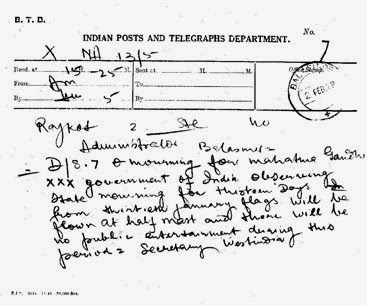
One more telegram sent by Government of India, Secretary Western India to Rajkot Administrator Balasinor- in message it was stated that:


"D/8.7 mourning for mahatma Gandhi XXX government of India observing State mourning for thirteen days from thirtieth January flags will be flown at half mast and there will be no public entertainment during this period. = Secretary Westindia"

Courtesy: Mr. Ashok Kumar Bayanwala, Ahmedabad.